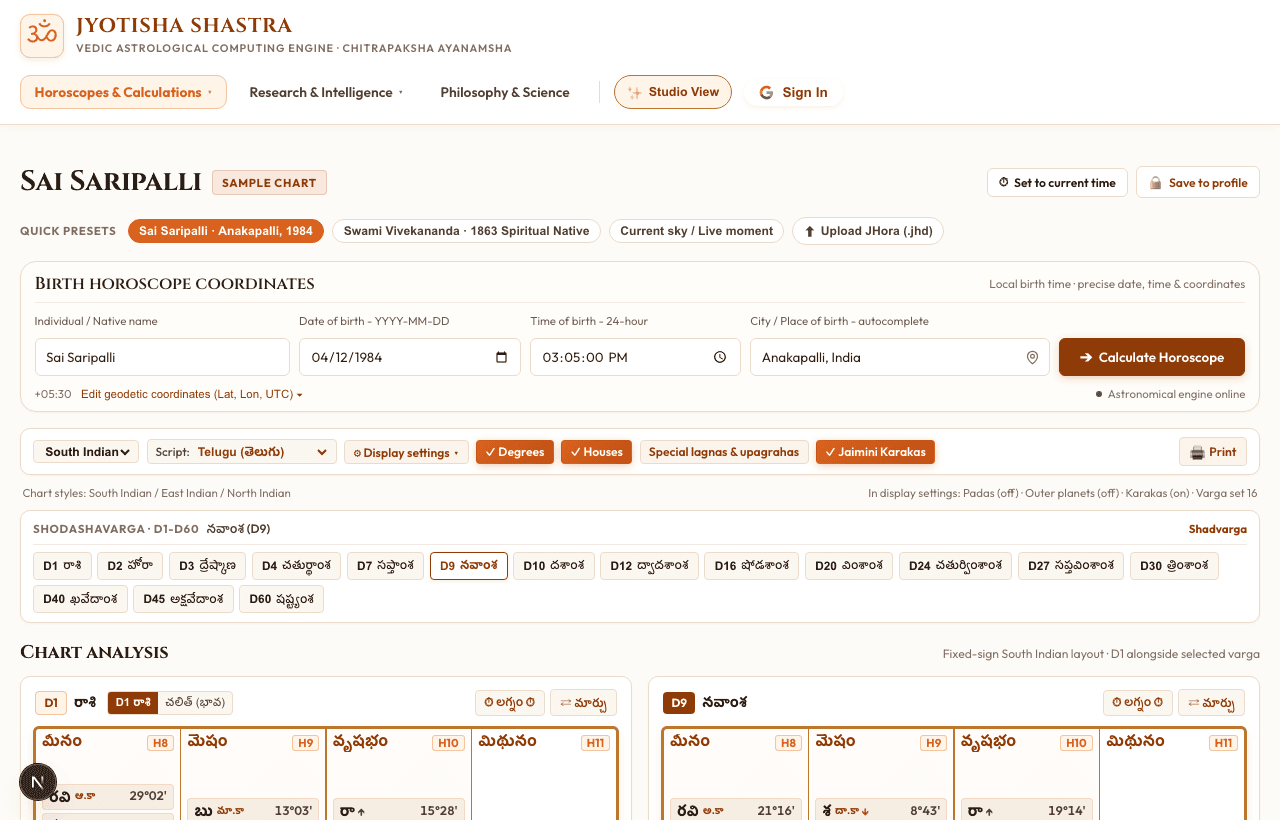
Enter exact birth details (date, hour, minute, second), resolve coordinates via offline geocoding, auto-detect location, or load presets.
🔍 Click to expand
Figure 1: Birth Data Input Form with Place Autocomplete & Quick Presets
📋 Step-by-Step Walkthrough
1
Enter Date and Exact Time of Birth
Provide Year, Month, Day, Hour, and Minute. For fine second-level calculations, accurate seconds can also be supplied.
2
Resolve Place Coordinates (Offline / Online)
Type any city, town, or village in the Place of Birth input. The high-speed geocoding resolver calculates exact latitude, longitude, and IANA timezone.
3
Use One-Click Current Location or Quick Presets
⌨️ Alt + LClick '📍 Current Location' to populate your browser's real-time GPS coordinates, or pick from verified classical historical presets.
4
Import Jagannatha Hora (.jhd) Chart Files
Click 'Import .jhd File' to upload any saved horoscope from Jagannatha Hora software. All planetary coordinates and birth timestamps parse automatically.
💡 Pro-Tip & Best Practice
Always verify the detected IANA timezone (e.g. 'Asia/Kolkata' or 'America/Los_Angeles') to prevent daylight saving offset discrepancies.
📜 Classical Shastra Foundation
Sūrya Siddhānta emphasizes that an error of even 4 minutes in recorded birth time shifts the Lagna (Ascendant) by roughly 1 whole degree.
#birth time#coordinates#geocoding#jhd#jagannatha hora#timezone#presets
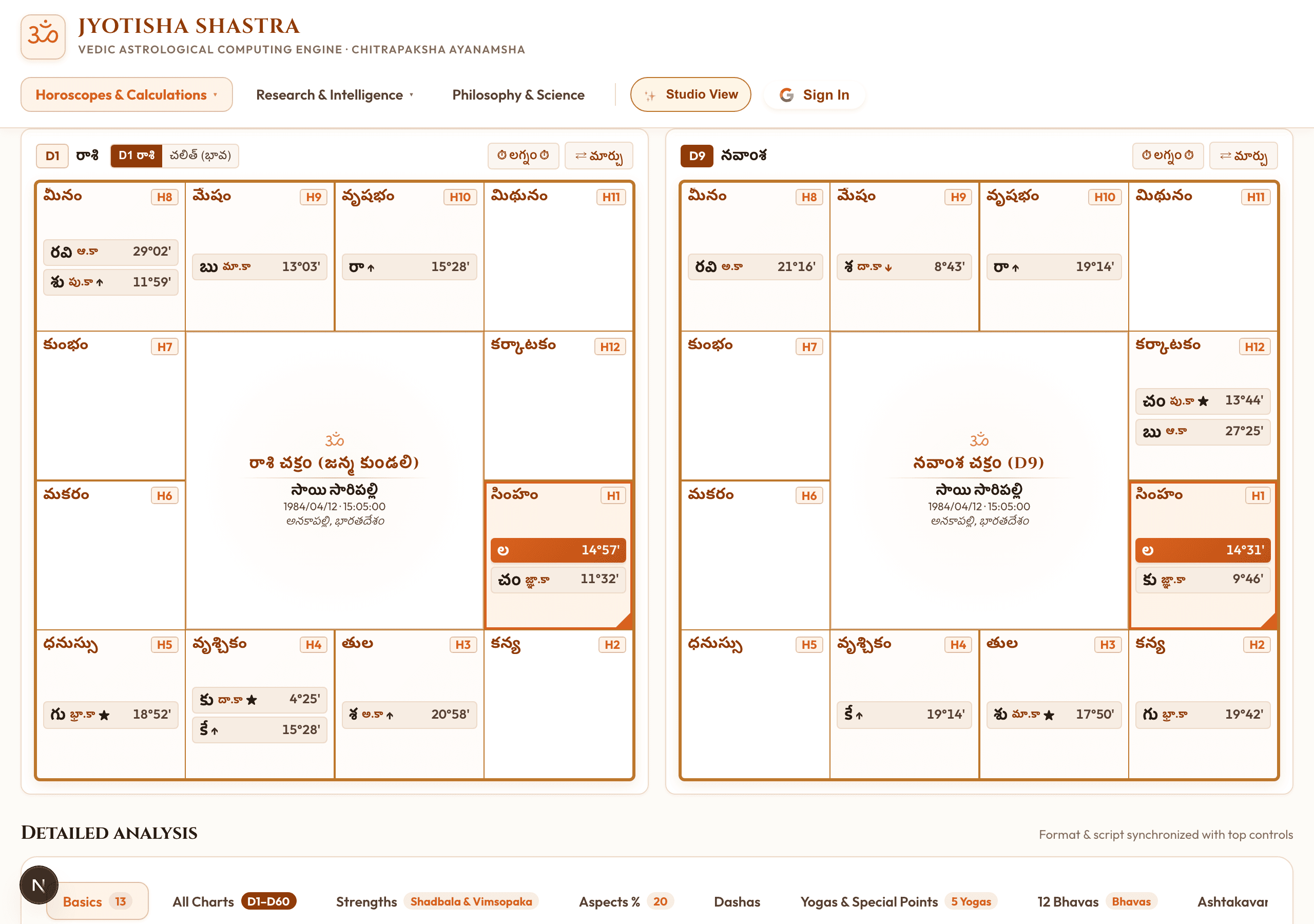
↑ TopExperience Vedic charts rendered in authentic South Indian, North Indian, East Indian, or Western Wheel diagrams across 10 vernacular scripts.
🔍 Click to expand
Figure 2: Classic and Studio Kundali View with Regional Layout & Vernacular Script Switcher
📋 Step-by-Step Walkthrough
1
Switch Between Classic and Studio Workspace Modes
⌨️ Alt + VUse the top header toggle to switch between 'Classic View' (clean, vertical narrative scroll) and 'Studio Mode' (dockable sidebars and research panels).
2
Select Your Preferred Kundali Diagram Style
Choose between South Indian (fixed sign, moving house), North Indian (fixed house, moving sign diamond), East Indian, or Western circular wheel.
3
Choose Vernacular Language Script
Select Telugu (default), Tamil, Kannada, Hindi, Gujarati, Marathi, Bengali, Malayalam, Oriya, or English for authentic native script representation.
4
Click Any House for Detailed Planetary Inspection
Click any zodiac house to reveal occupying grahas, degree minutes, nakshatras, padas, sign lords, and benefic/malefic aspects.
5
Toggle Special Mathematical Lagnas & Upagrahas
⌨️ Alt + SOpen '⚙ Display settings' or click the '+ Special Lagnas' button in the toolbar to display Hora Lagna (HL), Ghati Lagna (GL), Bhava Lagna (BL), Sree Lagna (SL), Gulika (Gk), and Mandi (Md) directly inside the Basics -> Planetary Positions & Classical Dignities (D1) table.
💡 Pro-Tip & Best Practice
In South Indian charts, Pisces is always top-left and Aries is second from left. In North Indian charts, the top center diamond is always House 1 (Lagna).
📜 Classical Shastra Foundation
Brihat Parashara Hora Shastra recognizes diverse regional depictions; the underlying sidereal math and Chitrapaksha Lahiri Ayanamsa remain invariant.
#south indian#north indian#east indian#classic view#studio mode#telugu#scripts#kundali#special lagnas#upagrahas#hora lagna#ghati lagna#gulika#mandi
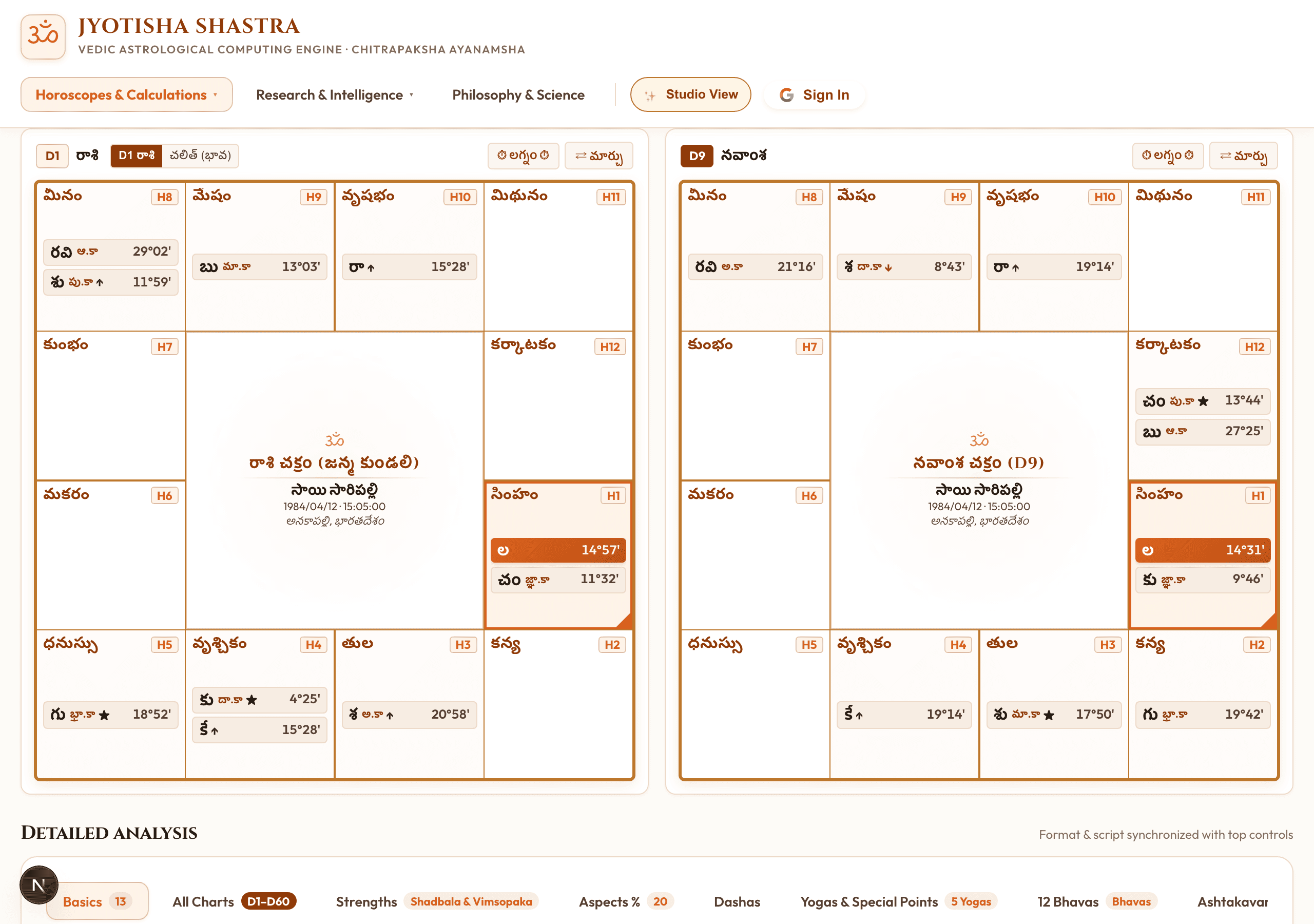
↑ TopInspect D1 (Rasi), D2 (Hora), D3 (Drekkana), D4 (Chaturthamsa), D7 (Saptamsa), D9 (Navamsha), D10 (Dasamsa), D12 (Dvadasamsa), up to D60 (Shashtiamsha).
🔍 Click to expand
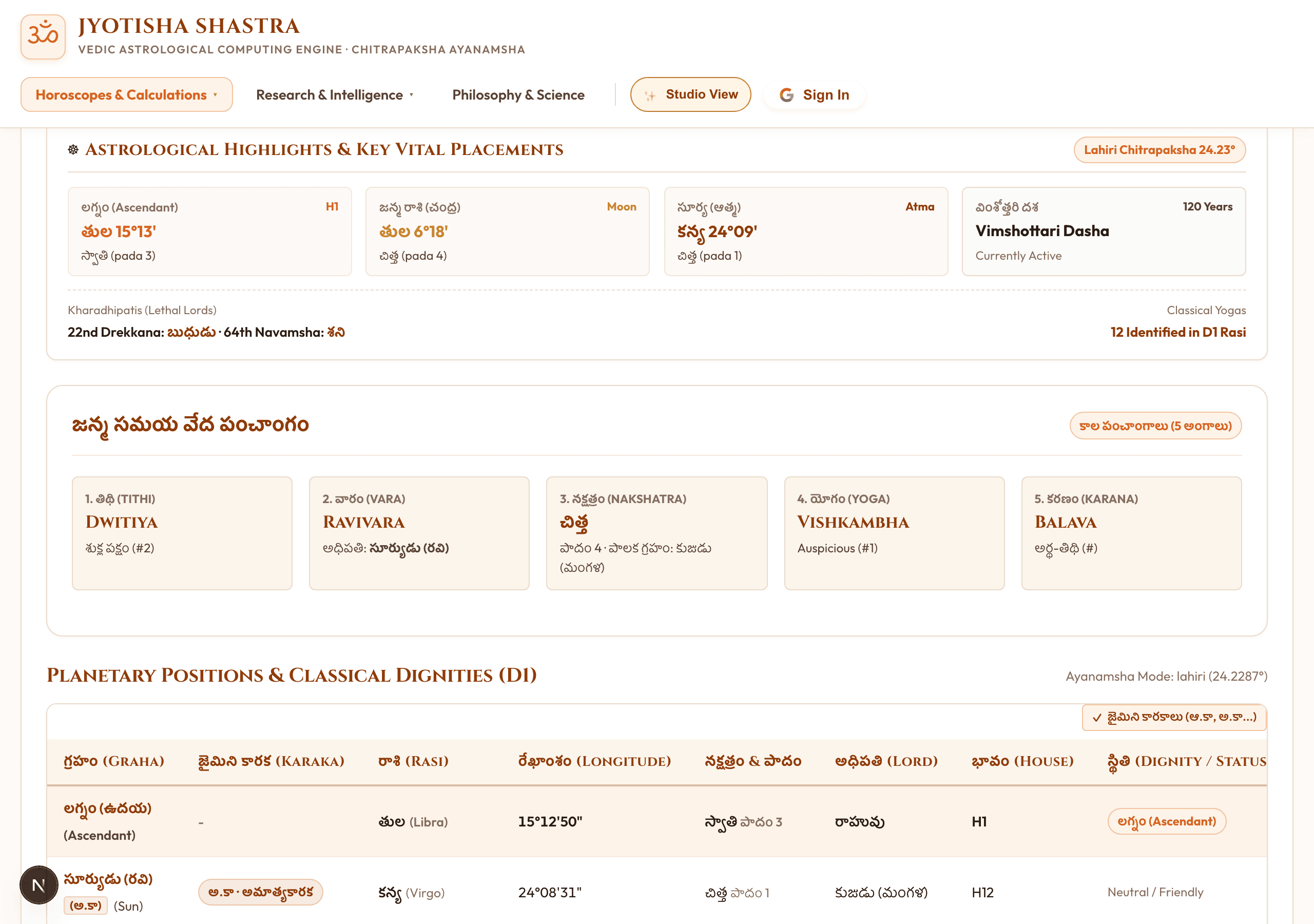
Figure 3: Shodashavarga Divisional Selector and D9 Navamsha Chart
📋 Step-by-Step Walkthrough
1
Select Any Divisional Chart from the Varga Selector
Click on the Varga pill tabs (D1, D2, D3, D4, D7, D9, D10, D12, D16, D20, D24, D27, D30, D40, D45, D60) to render that harmonic division instantly.
2
Check Vargottama Planets in D9 Navamsha
Identify planets occupying the exact same sign in both D1 (Rasi) and D9 (Navamsha). Vargottama planets bestow extraordinary strength and stability.
3
Analyze Career in D10 Dasamsa
Inspect the 10th house, 10th lord, and planetary placements in D10 to evaluate profession, status, and leadership achievements.
4
Inspect D60 Shashtiamsha for Karmic Roots
Examine D60 for sub-arc past karma and subtle karmic dispositions. D60 changes sign every ~2 minutes, making it the supreme rectification chart.
💡 Pro-Tip & Best Practice
The computation engine computes all 16 divisional charts in memory on the initial chart load, allowing 0ms instant tab switching with zero network lag.
📜 Classical Shastra Foundation
Parashara states: 'Ṣaṣṭyaṁśe sampradṛṣṭe tu phalaṁ sarvaṁ vinirdiśet' — Without validating the D60 Shashtiamsha, no prediction is final.
#vargas#shodashavarga#navamsha#dasamsa#d60#vargottama#d9#d10
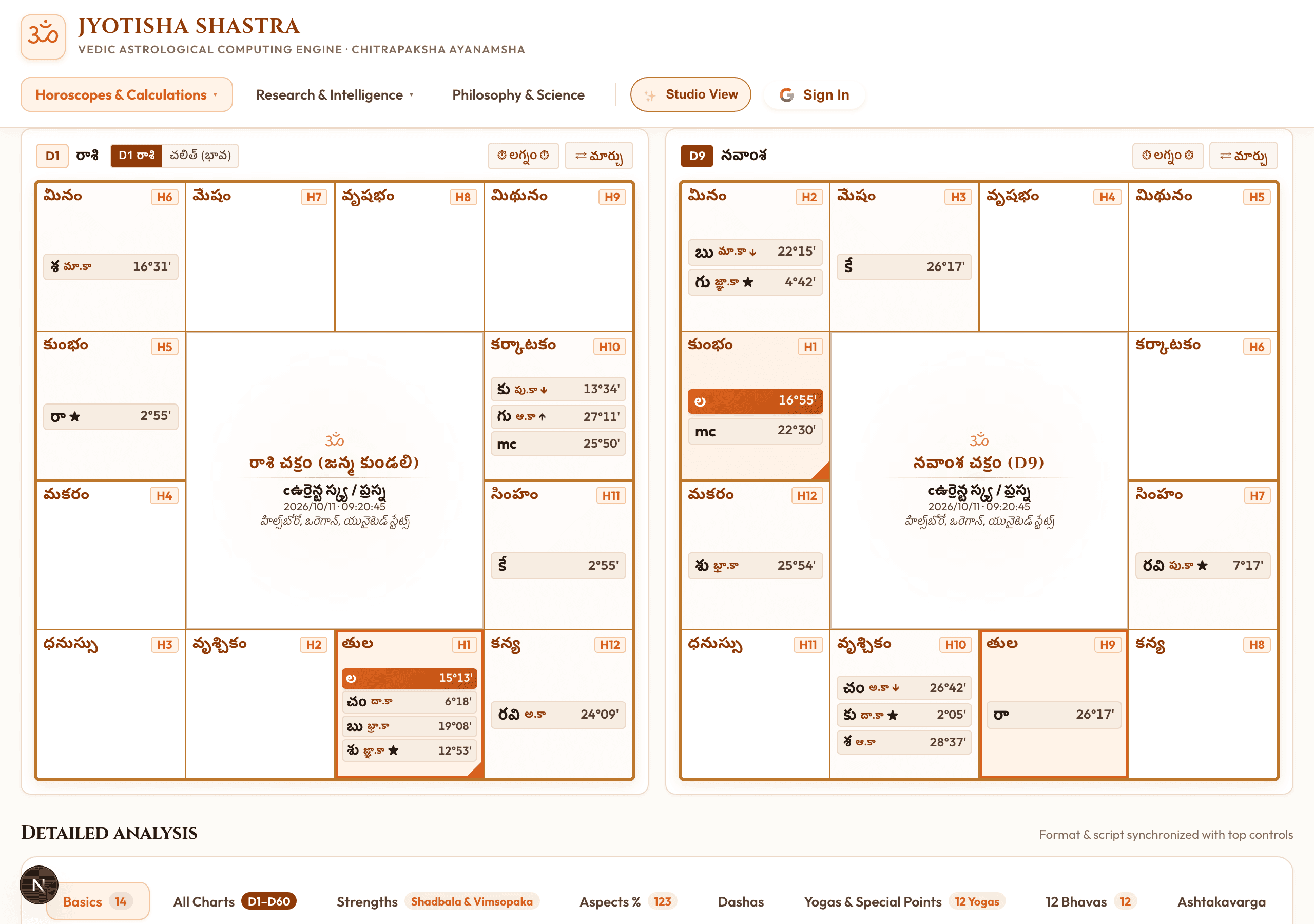
↑ TopRight-click any divisional chart or click '⏱ Lagna' to calculate how many minutes/seconds earlier or later the Lagna changes signs, and test adjusted times in 1 click.
🔍 Click to expand
Figure 4: Classical Lagna Transition Timing Modal with One-Click Simulation
📋 Step-by-Step Walkthrough
1
Trigger the Timing Modal
⌨️ Right-Click ChartRight-click on any divisional chart (D1 to D60), or click the '⏱ Lagna' quick-action button in the chart header.
2
Review the Classical Transition Timing Rule
Read the exact earlier transition duration (e.g., '-6 min 52 sec') and later duration (e.g., '+2 hr 00 min 06 sec') alongside the target zodiac signs.
3
Evaluate Side-by-Side Transition Breakdown Cards
Compare the earlier and later transition cards to see the calculated adjusted birth times (HH:MM:SS) formatted in your chosen numeral system.
4
Test Adjusted Times with One Click
Click '⚡ Test This Time' on either card. The platform re-evaluates the entire horoscope instantly to let you inspect life event alignments.
💡 Pro-Tip & Best Practice
Use higher divisional charts like D9, D10, and D60 for precision BTR. D60 transitions every ~2 minutes, pinpointing exact birth minutes and seconds.
📜 Classical Shastra Foundation
Ascendant boundary evaluation is the classical cornerstone for reconciling discrepancies between recorded hospital clock time and true epoch time.
#lagna change#birth time rectification#btr#ascendant change#earlier#later#timing
↑ TopAnalyze Bhava Chalit using Sripati Unequal Quadrant Trisection or Equal 30° Chalit with Lagna as Madhya (±15°) to reveal planet house shifts.
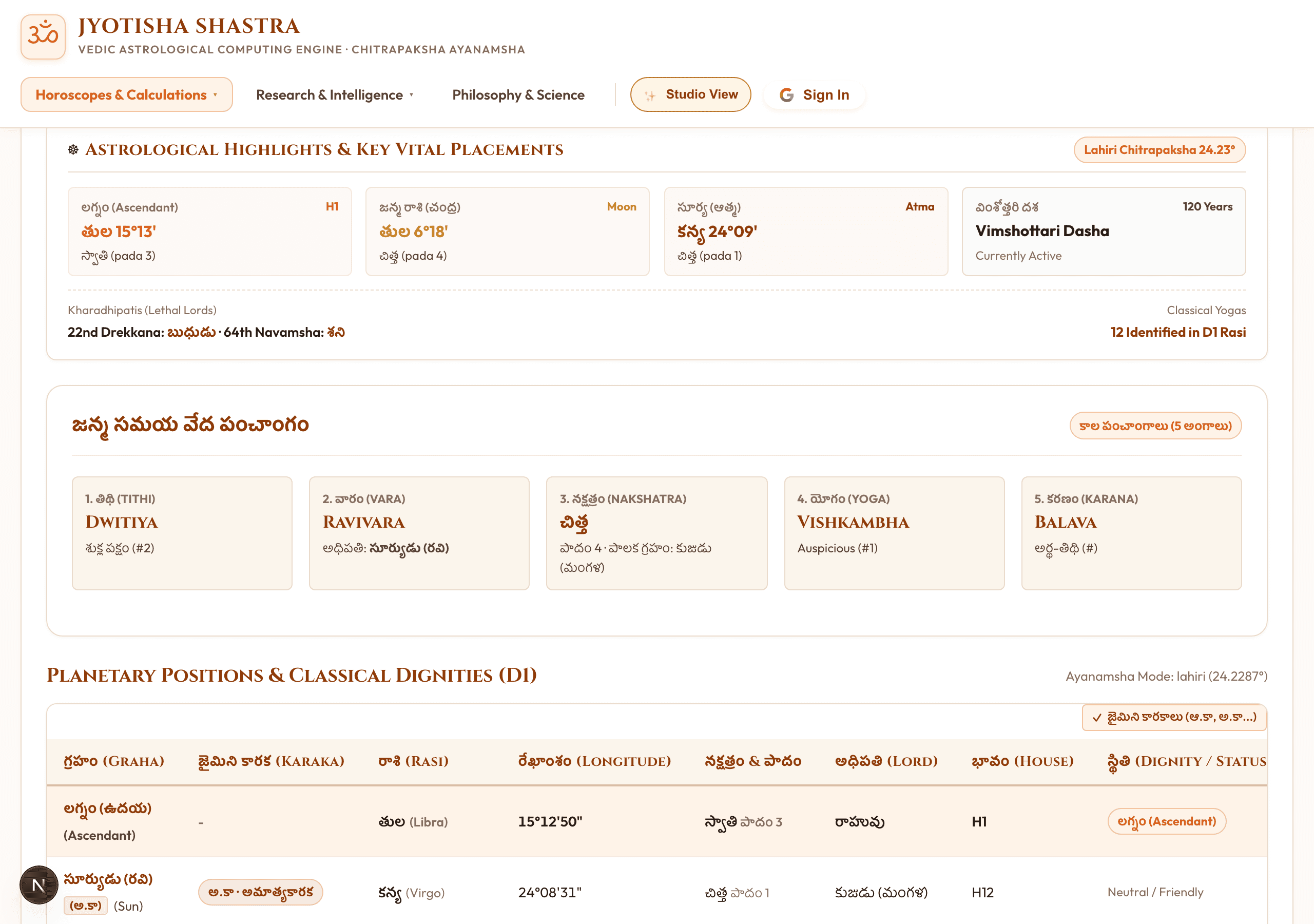
🔍 Click to expand
Figure 5: Bhava Chalit Cusp Analysis and Planetary House Relocations
📋 Step-by-Step Walkthrough
1
Open the Bhava Chalit Section
Navigate to the Bhava Chalit panel in the chart analysis tab to inspect actual house cusps (Bhava Madhyas) and boundaries (Bhava Sandhis).
2
Toggle Chalit Calculation Systems
Switch between 'Equal 30° Bhava Chalit' (Lagna degree as cusp center ±15°) and 'Sripati Unequal Quadrant' (trisection between Ascendant and Midheaven).
3
Identify Shifted Planets
Look for indicator badges highlighting grahas that shifted into an adjacent house in Bhava Chalit compared to their whole-sign Rasi house.
💡 Pro-Tip & Best Practice
A planet in the 10th sign from Lagna in D1 that shifts to the 9th house in Bhava Chalit will deliver 9th house bhava-phala during its dasha.
📜 Classical Shastra Foundation
Classical texts state: 'Rāśi sthitiḥ phalaṁ dīptam, bhāva sthitiḥ phalaṁ kriyām' — Rasi reveals innate state, while Bhava governs actual manifest action.
#bhava chalit#sripati#equal house#madhya#sandhi#cusps
↑ Top⏳
AnalysisModule 6
Planetary Dashas (Vimshottari & Tithi Ashtottari)
Explore Vimshottari Mahadasha, Antardasha, and Pratyantardasha hierarchies, passed periods, proportional sub-spans, and current running periods.
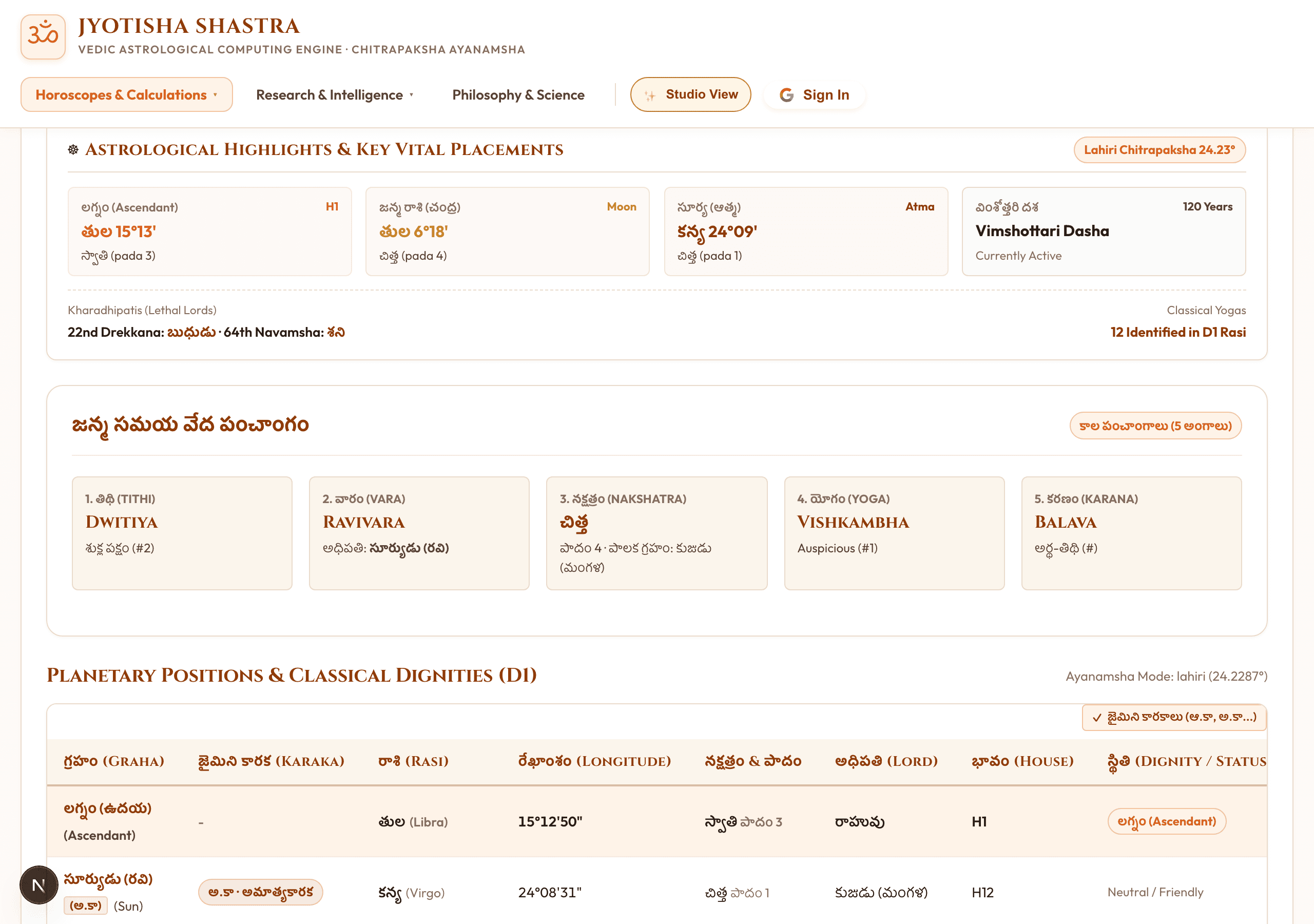
🔍 Click to expand
Figure 6: Interactive Vimshottari Dasha Drill-Down Tree and Current Dasha Highlight
📋 Step-by-Step Walkthrough
1
View the Current Running Dasha
The Dasha header prominently displays your active Mahadasha, Antardasha, and Pratyantardasha alongside remaining duration and start/end dates.
2
Expand Dasha Levels for Deep Timeline Exploration
Click any Mahadasha row to expand its 9 Antardashas, and click any Antardasha row to reveal its 9 Pratyantardasha micro-periods.
3
Inspect Historical Passed Dashas
Review past dasha periods to verify major life milestones (education, marriage, career shifts) and validate chart rectification.
💡 Pro-Tip & Best Practice
The dasha balance at birth is derived precisely from Moon's nakshatra longitude: degrees traversed within the 13°20' nakshatra span determine initial elapsed time.
📜 Classical Shastra Foundation
Vimshottari Dasha, based on 120 years of human lifespan, is designated by Sage Parashara as the supreme predictive dasha for the Kali Yuga.
#vimshottari#dasha#mahadasha#antardasha#pratyantardasha#nakshatra lord#timeline
↑ TopUnlock the Sage Jaimini Upadesha Sutras: compute the 7 Chara Karakas (AK, AmK, BK, MK, PK, GK, DK), Karakamsha, Rashi Drishti, and Chara Dasha.
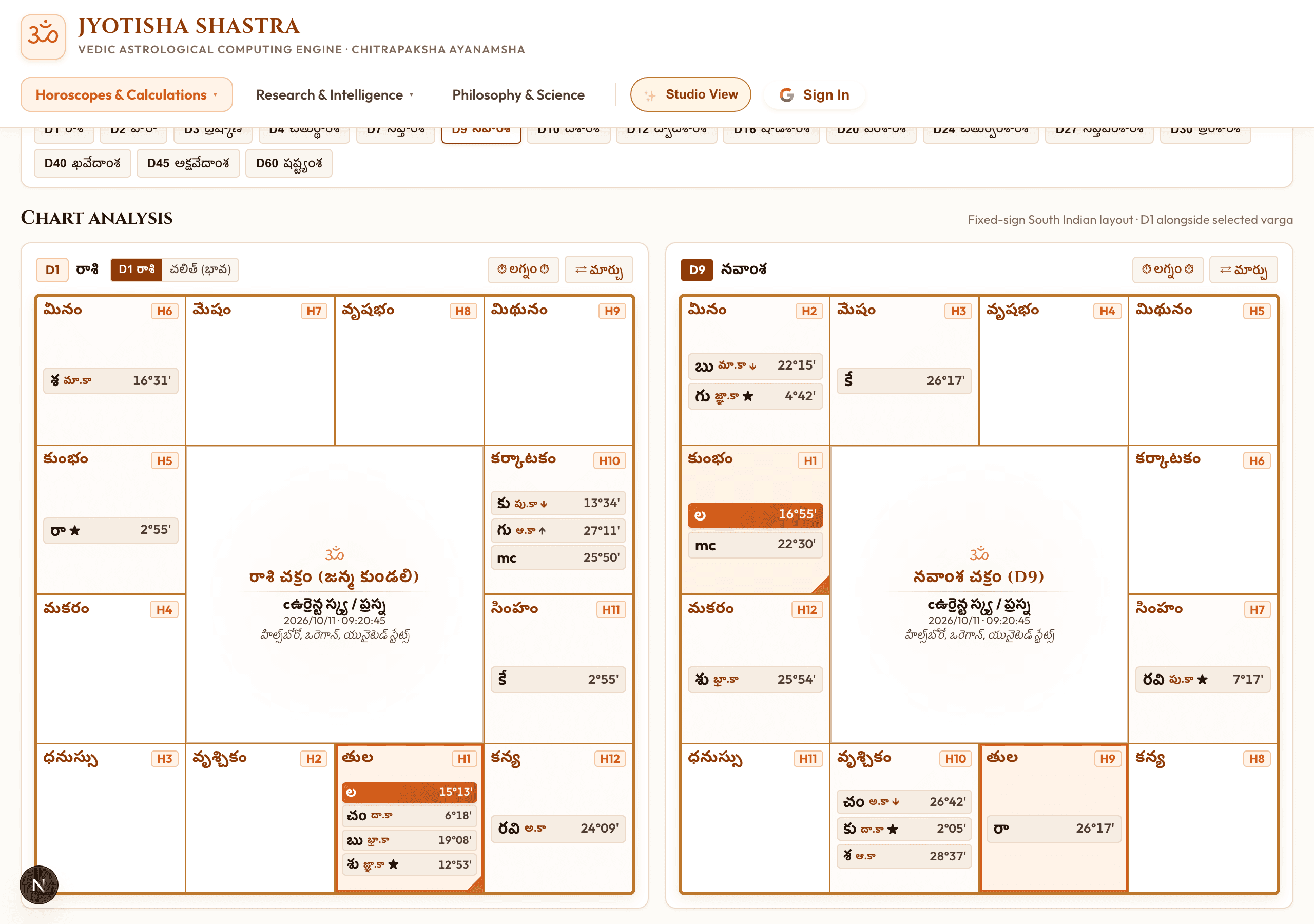
🔍 Click to expand
Figure 7: 7 Chara Karakas Table and Jaimini Rashi Drishti Aspect Matrix
📋 Step-by-Step Walkthrough
1
Inspect the 7 Chara Karakas Table
View planets ranked by descending degrees: Atmakaraka (soul's purpose), Amatyakaraka (career), Bhratrukaraka, Matrukaraka, Putrakaraka, Gnatikaraka, and Darakaraka (spouse).
2
Analyze Jaimini Rashi Drishti (Sign Aspects)
Understand classical sign drishti: Movable signs aspect all Fixed signs (except adjacent); Fixed signs aspect Movable; Dual signs aspect all other Dual signs.
3
Identify Jaimini Raja Yogas
Detect powerful associations between Atmakaraka (AK), Amatyakaraka (AmK), and the 5th lord in D1 and D9 (Karakamsha).
4
Explore Jaimini Chara Dasha
Track 12 sign dasha periods calculated with direct/indirect progression rules based on odd/even sign characteristics.
💡 Pro-Tip & Best Practice
If Rahu has a higher longitudinal degree in sign than any classical planet, Jaimini treatises count 30° minus Rahu's longitude to evaluate its Chara Karaka rank.
📜 Classical Shastra Foundation
Maharshi Jaimini's aphorisms operate on Sign aspects (Rāśi Dṛṣṭi) and Sign Dashas rather than solely Graha Drishti, revealing subtle spiritual and worldly fate.
#jaimini#chara karaka#atmakaraka#amatyakaraka#rashi drishti#chara dasha#karakamsha
↑ TopCalculate the exact moment the Sun and Moon achieve the exact angular elongation of your birth moment in any target year, revealing the Year Lord (Varesha).
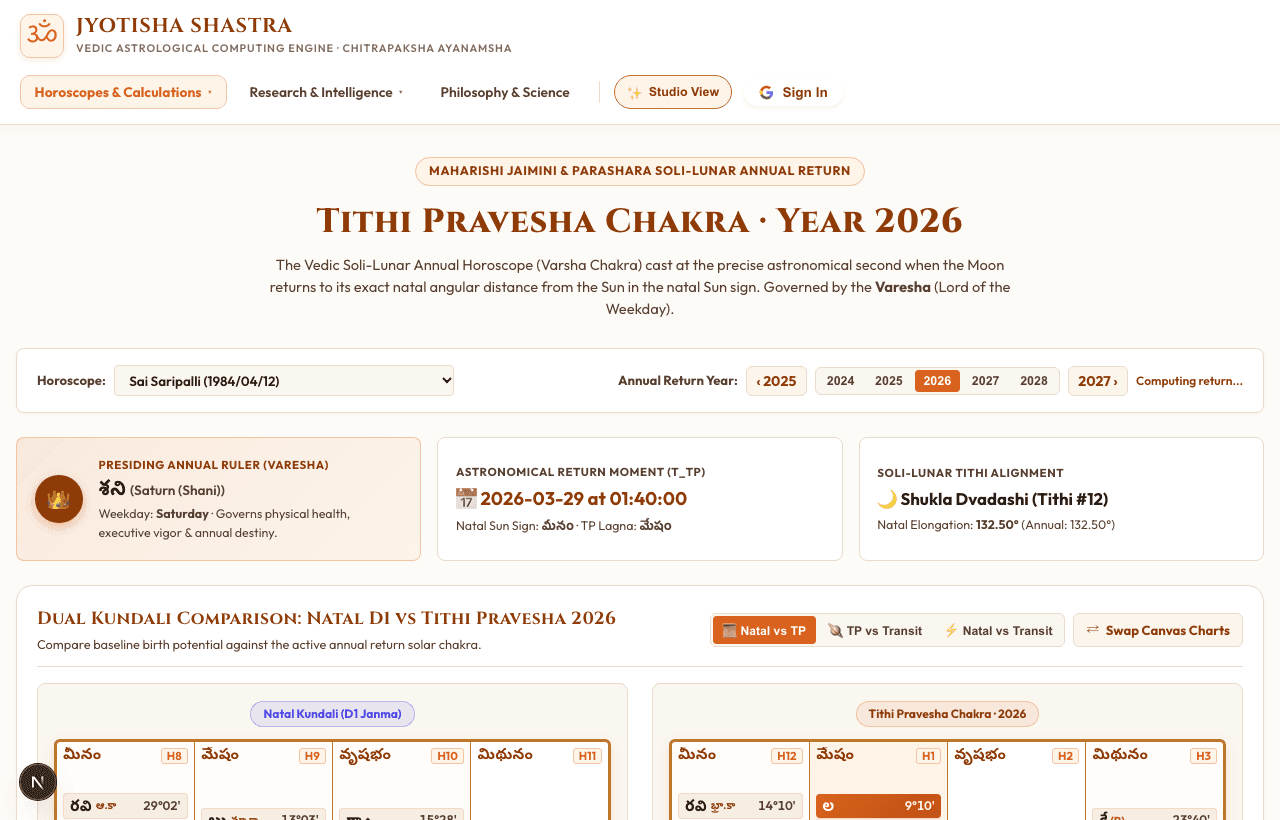
🔍 Click to expand
Figure 8: Tithi Pravesha Annual Return Chart with Varesha Lord & Dual Kundali Comparison
📋 Step-by-Step Walkthrough
1
Navigate to the Tithi Pravesha Module
Access `/tithi-pravesha` from the main navigation header or top horoscopes dropdown.
2
Select the Target Annual Year
Input any calendar year (e.g., 2026). The astronomical engine solves the exact return moment to sub-second precision using Swiss Ephemeris math.
3
Identify the Year Lord (Varesha)
Inspect the ruler of the Vedic weekday active at the return moment. The Varesha's placement, strength, and house lordship dictate the theme of the year.
4
Analyze Compressed 1-Year Tithi Ashtottari Dasha
Review the 365-day compressed Dasha cycle initiated by the Varesha nakshatra to forecast exact months and weeks for key annual developments.
5
Toggle Dual Comparison Mode
View your Natal Birth Chart (D1) side-by-side with the Annual Return Chart (TP D1) to observe transiting alignments over natal sensitive points.
💡 Pro-Tip & Best Practice
Unlike Western Solar Returns which calculate Sun's return alone, Vedic Tithi Pravesha preserves the sacred harmony between Soul (Sun) and Mind (Moon).
📜 Classical Shastra Foundation
As taught in classical tradition, the planet ruling the weekday at the exact Tithi return moment acts as the supreme governor of the individual's annual karma.
#tithi pravesha#annual chart#varesha#solar lunar return#year lord#tithi ashtottari
↑ TopExplore comprehensive Vedic Panchangam capabilities aligned with Pandit Mahesh Shastriji's mypanchang.com Drishya Ganita baseline. Features an authentic classical newspaper dossier slip, space-optimized regional traditions ribbon (Telugu, Tamil, Kannada, Gujarati, Marathi, Bengali, Odia, Malayalam, Assamese) with automatic native script localization, high-precision astronomical sunrise/sunset (solar disc center with 34' refraction), upcoming Hindu festivals feed, and deep mathematical and spiritual foundations.
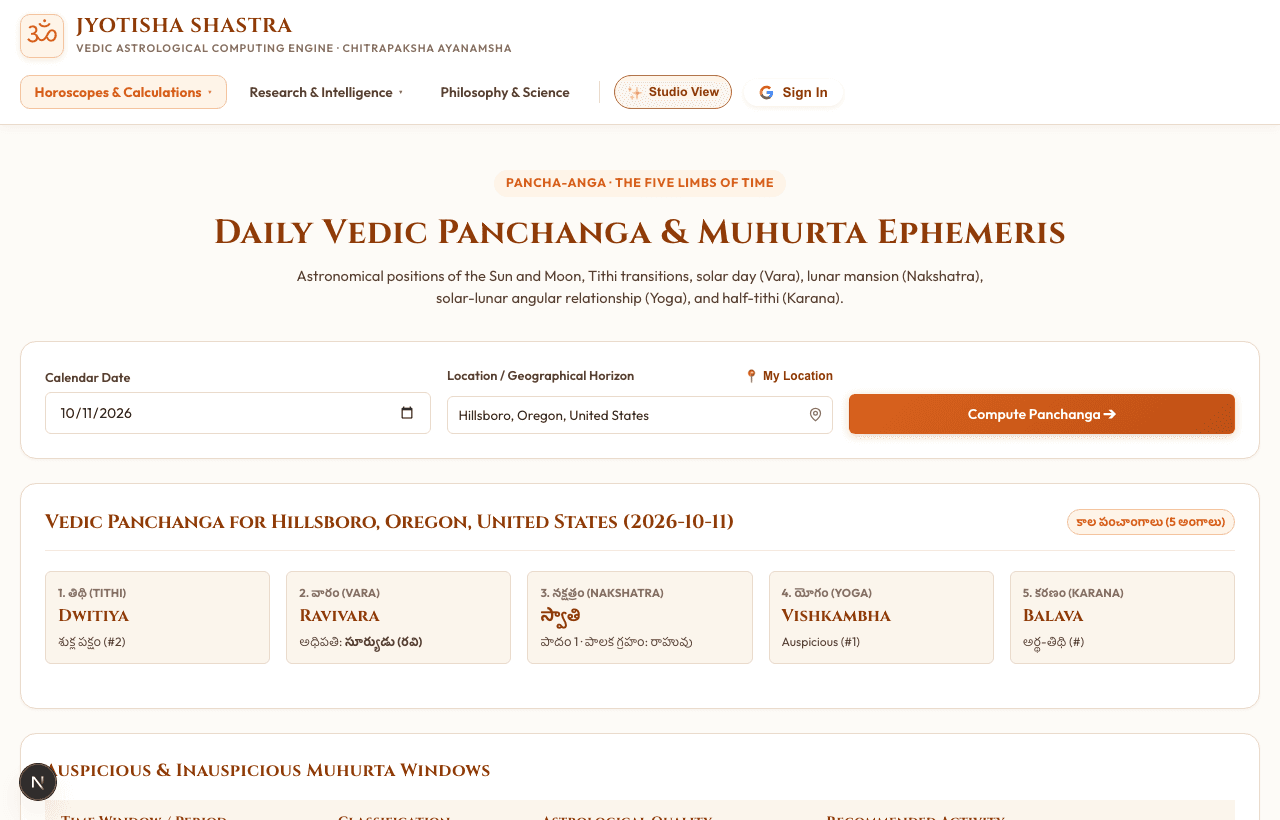
🔍 Click to expand
Figure 9: Vedic Panchangam Suite with Classical Drishya Ganita Slip & Regional Panjika Switcher
📋 Step-by-Step Walkthrough
1
Default Landing in Dainik Detailed Panchangam
Instantly inspect the complete daily ephemeris upon visiting /panchang, defaulted to Visakhapatnam, Andhra Pradesh, India when location permissions are pending.
2
Classical Drishya Ganita Almanac Slip (Screenshot-3 Format)
View the authentic traditional newspaper-style day dossier featuring a prominent date number badge, solar disc center rise/set times, Shaka Samvat (Parabhava), Vikrami (North 2083, Siddhaarthi, Gujarat 2082), Ayana (Dakshinayana/Uttarayana), Ritu, Tamil Solar Month, Chandramasa, 5 Limbs with exact end times, red rule dividers, and standard Muhurtha windows (RK, YM, GK, AJ, DM, V, AK, Nethram, Jeevanam).
3
Compact Regional Traditions & Instant Vernacular Localization
Easily switch traditions using the space-optimized ribbon (<38px height). Selecting Telugu Panchangam, Tamil Panchangam, Kannada Panchangam, Gujarati, Marathi, Bengali, Odia, Malayalam, or Assamese automatically localizes both the Month Calendar Grid and Detailed Day Slip into that region's native script!
4
High-Precision Astronomical Solar & Muhurtha Engine
Calculates dynamic 8-part diurnal windows for Rahu Kalam, Yamagandam, and Gulika Kalam, 15-part daylight windows for Abhijit and Durmuhurtam, and Nakshatra-based Tyajya (Varjyam) and Amrita Kalam matching mypanchang.com to within 1 second.
5
Upcoming Hindu Festivals & Sacred Observance Iconography
Authenticated users receive a personalized monthly calendar of upcoming fasts, Ekadashis, Pradoshams, Sankashti Chaturthis, Pournami, and Amavasya tailored to their exact geographic horizon, accented with sacred icons.
6
Spiritual & Mathematical Foundations Reference
Access in-depth Siddhantic explanations of Tithi (12° solilunar angular distance and vital prana), Nakshatra (27 asterisms and cosmic consciousness), Yoga (solilunar longitudinal sum and bodily longevity), Karana (half-tithi and physical execution), 60-year Jovian Samvatsaras (including Parabhava), and Ayana (Uttarayana vs Dakshinayana) with classical citations from Surya Siddhanta, Brihat Parasara Hora Shastra, and Bhagavad Gita.
💡 Pro-Tip & Best Practice
Toggle between the 'Classical Almanac Slip' for authentic traditional reading and the 'Detailed Metrics View' for modern color-coded cards and graphs.
📜 Classical Shastra Foundation
Sage Vyasa writes: 'Tithis ca śriyaṁ vṛddhiḥ, vārā dīrgham āyuḥ, nakṣatrā dharate pāpam' — Knowledge of Panchangam bestows longevity, prosperity, and purity.
#vedic panchangam#month panchangam#dainik panchangam#telugu panchangam#tamil panchangam#kannada panchangam#mypanchang#parabhava#dakshinayana#rahu kalam#varjyam#amrita kalam
↑ TopEvaluate transiting planets, Sade Sati timeline (Rising, Peak, Setting phases), Kantaka Shani, Ashtama Shani, and real-time Spashta Drishti aspects.
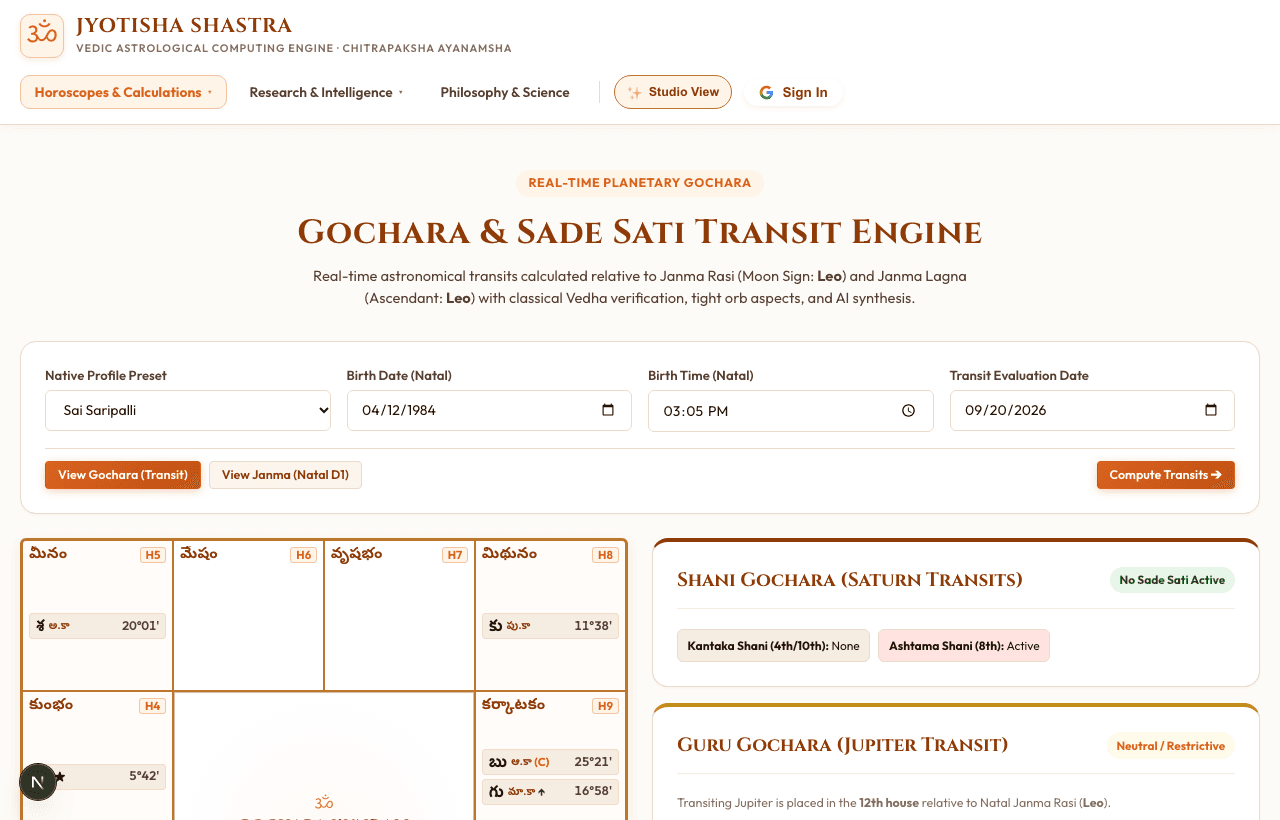
🔍 Click to expand
Figure 10: Real-Time Gochara Transit Chart with Saturn Sade Sati Analysis
📋 Step-by-Step Walkthrough
1
Access the Transit Analysis Page
Click 'Transits' from the top navigation to evaluate current planetary positions computed against your natal chart.
2
Analyze the Sade Sati Timeline
If Saturn transits the 12th, 1st, or 2nd house from your natal Moon, inspect the Sade Sati status badge, active phase, start date, peak moment, and end date.
3
Check Kantaka and Ashtama Shani
Detect special transit afflictions when Saturn enters the 4th, 8th, or 10th houses from natal Moon or Lagna.
4
Inspect Real-Time Aspect Influences
Review exact transiting aspects (Virupas / Spashta Drishti) cast by slow-moving planets (Saturn, Jupiter, Rahu, Ketu) onto natal sensitive points.
💡 Pro-Tip & Best Practice
Gochara effects should always be cross-referenced with your active Vimshottari Dasha. An adverse transit during an exalted benefic Mahadasha is greatly tempered.
📜 Classical Shastra Foundation
Phaladeepika Chapter 26 outlines exact auspicious transit houses for each graha counted from natal Chandra (Moon).
#transits#gochara#sade sati#saturn transit#ashtama shani#kantaka shani
↑ TopExamine Six-Fold Planetary Strength (Shadbala in Virupas and Rupas) and the 8-fold Ashtakavarga system (Bhinna BAV and Sarvashtakavarga SAV matrices).
🔍 Click to expand
Figure 11: Shadbala Six-Fold Planetary Strength and Sarvashtakavarga (SAV) Matrix
📋 Step-by-Step Walkthrough
1
Navigate to the Strengths Dashboard
Inspect the Shadbala card to see each planet's total score in Rupas and Virupas compared against classical minimum strength requirements.
2
Analyze the 6 Component Balas
Examine Sthanabala (positional), Digbala (directional), Kaalabala (temporal), Cheshtabala (motional), Naisargikabala (natural), and Drikbala (aspectual).
3
Review Sarvashtakavarga (SAV) House Totals
Check the bindu counts (out of 337 total) across the 12 houses. Houses with 28+ bindus are strong; houses with under 25 bindus require care during transits.
4
Inspect Individual Bhinna Ashtakavarga (BAV)
View each individual planet's 8-fold contribution matrix to understand where each graha grants benefic bindus.
💡 Pro-Tip & Best Practice
Sun in 10th, Jupiter/Mercury in 1st, Venus/Moon in 4th, and Saturn in 7th receive maximum Digbala (60 Virupas), granting exceptional directional prowess.
📜 Classical Shastra Foundation
Brihat Parashara Hora Shastra dedicates exhaustive chapters to Ashtakavarga Shodhaya Pinda as the primary metric for longevity and asset acquisition.
#shadbala#ashtakavarga#sav#bav#digbala#sthanabala#bindus#planetary strength
↑ TopQuery multi-trait combinations across thousands of planetary rules, explore verified Phaladeepika yogas, and stage custom astrological rules.
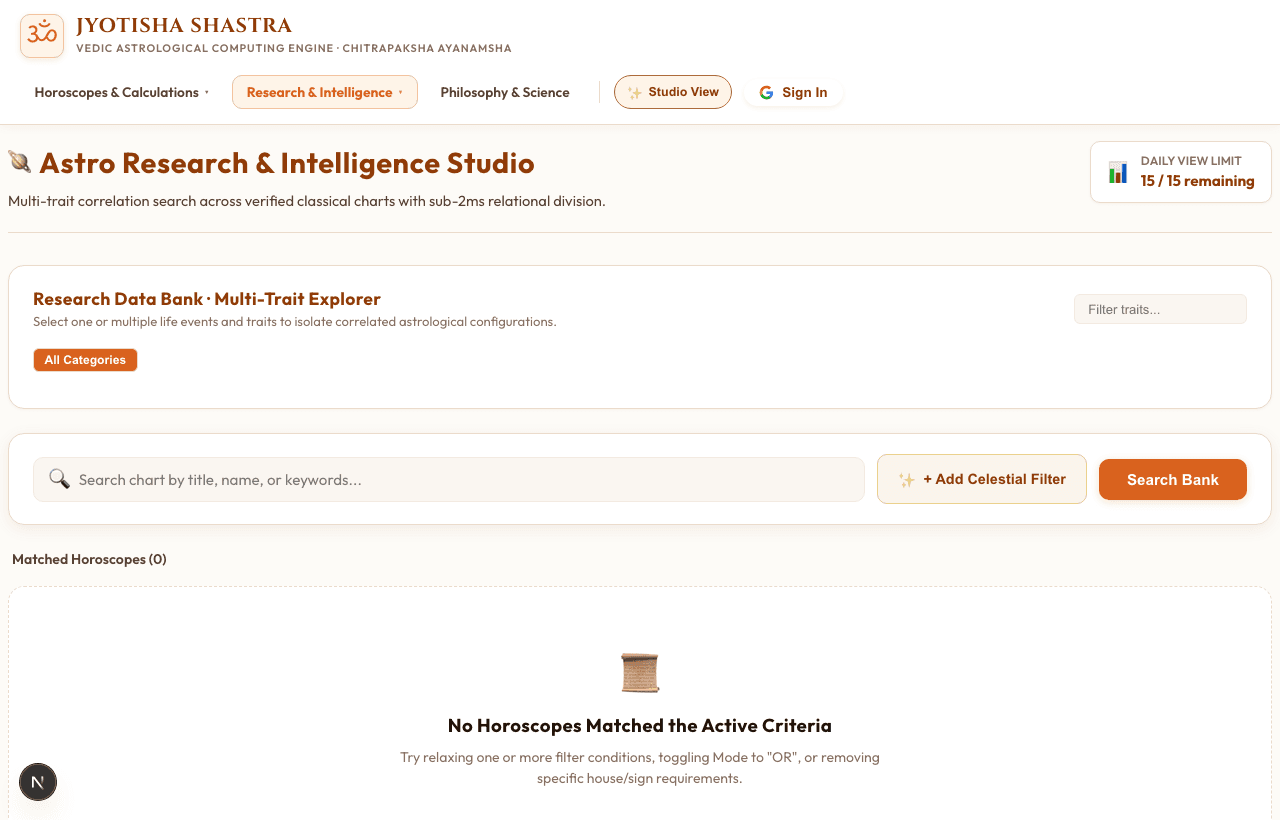
🔍 Click to expand
Figure 12: Astro Research Bank with Multi-Trait Filter & Rule Staging Studio
📋 Step-by-Step Walkthrough
1
Launch the Research Bank
Access `/research` or dock the Research Sidebar in Studio Mode to search classical yogas and combinatorial rules.
2
Compose Multi-Trait Research Queries
Filter by planet, sign, house, aspect, or classical category (e.g., 'Jupiter in 9th' + 'Saturn aspecting 10th').
3
Review Detected Yogas with Classical Sanskrit Slokas
Browse detected Pancha Mahapurusha, Raja, Dhana, and Kartari yogas with source references from Phaladeepika and Brihat Parashara.
4
Access the Rule Studio (Admins & Researchers)
Stage, test, and approve custom rule definitions in `/studio/rules` with strict role-based audit validation.
💡 Pro-Tip & Best Practice
Use the Research Engine to verify rare planetary configurations before formulating consultations or academic papers.
📜 Classical Shastra Foundation
The engine adheres to classical algorithmic purity, enforcing Spashta Drishti thresholds (aspects >= 45 virupas) before confirming yoga triggers.
#research#rule studio#yogas#combinatorial#phaladeepika#slokas#traits
↑ TopSign in securely with Google OAuth, sync horoscopes to your personal library, tag records, and export crisp, high-resolution PDF printouts.
🔍 Click to expand
Figure 13: Saved Horoscopes Library and Publication-Quality Print Export View
📋 Step-by-Step Walkthrough
1
Sign in with Google OAuth
Click the Sign-In button in the header. Your user account syncs seamlessly with Neon PostgreSQL, unlocking cloud chart persistence.
2
Save Horoscopes with Tags and Notes
Click '💾 Save Chart' to store any generated horoscope with personalized notes, tags, and client reference IDs.
3
Search & Filter Saved Library
Access `/profile` to view your paginated collection of saved horoscopes, search by client name or birth date, and load charts in 1 click.
4
Generate Publication-Quality Print / PDF Export
⌨️ Ctrl + P / Cmd + PClick '🖨️ Print / Export' in the chart header. The engine formats the horoscope with crisp vector typography, Sanskrit invocations, and clean page breaks.
💡 Pro-Tip & Best Practice
The print engine automatically strips UI buttons, sidebars, and dark mode backgrounds, outputting high-contrast black-and-gold layouts optimized for physical paper printing.
📜 Classical Shastra Foundation
Every printed chart features traditional auspicious invocations (Dakshinamurthy Stotram) reflecting sacred scholarly heritage.
#save chart#pdf export#print#google oauth#neon postgres#client library#profile
↑ Top